

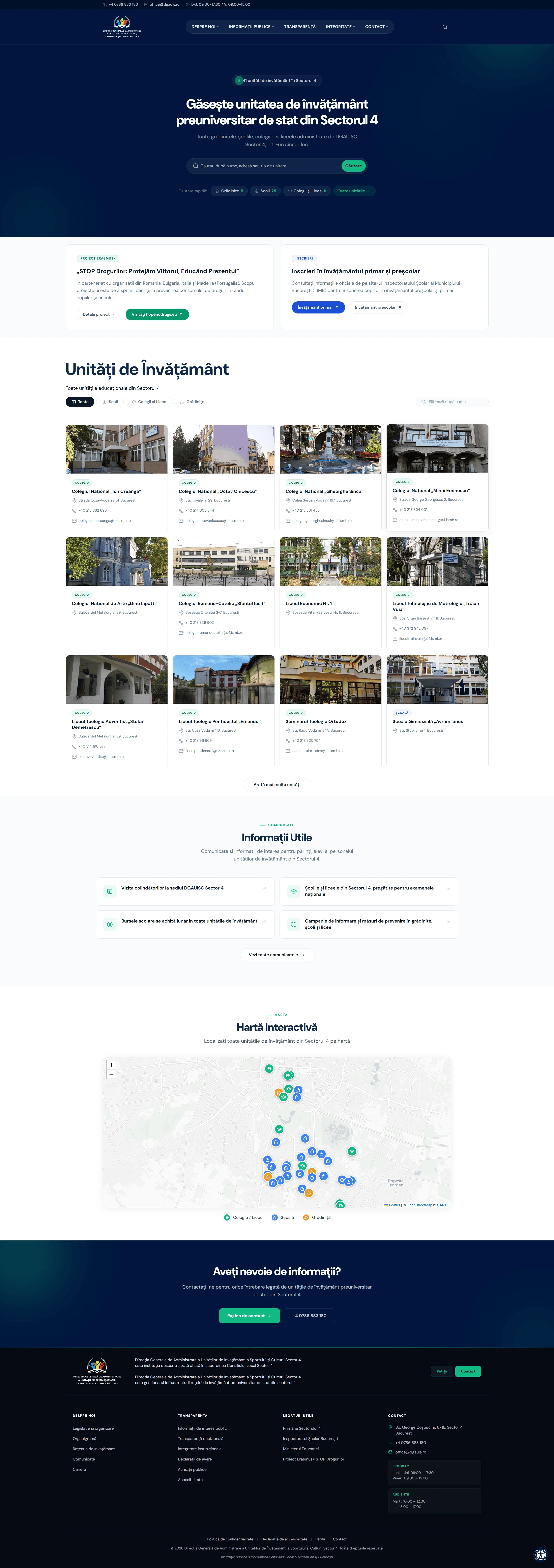

Overview
DGAUIS is the Sector 4 city hall department in Bucharest responsible for administering the physical infrastructure of 40 state schools, kindergartens, colleges, and special schools — everything from buildings and grounds to sport facilities and cultural spaces. They needed an official platform that serves parents, students, school staff, suppliers, and citizens of the sector. What they asked for was a government site. What we built was a government site that doesn't look or feel like one.
The Challenge
Romanian government websites have a reputation, and it's not a good one. Dated templates. Impossible navigation. Mandatory transparency sections that nobody can find. Forms that don't work on phones. The irony is that these sites have one of the hardest audiences in the world — parents trying to find out when their child's school has its next open day, suppliers checking on a public procurement notice, citizens filing a formal complaint — and they almost universally fail to serve any of them well.
DGAUIS wanted to be different. They had 40 institutions to represent, legal transparency obligations to meet, petition and complaint intake to handle, and a public audience with wildly varying technical comfort — from teachers in their 20s to grandparents picking up a kid from kindergarten. The site had to work for all of them.
The Approach
We built it as a custom platform from scratch (dgauis, a site-specific architecture — not a marketplace template, not a page builder). Every component was hand-designed and hand-coded, because government sites have specific needs: accessibility is non-negotiable (by law), performance matters (because half the users are on slow mobile connections), and maintainability matters (because the internal team has to be able to update content for years without calling us).
We treated the 40 schools as the core dataset of the platform. Everything else — the transparency sections, the forms, the institutional communication — would be built around them. And the 40 schools needed to be explorable in multiple ways: visually (on a map), by type (schools, colleges, kindergartens, special schools), and by search.
The Solution
- Custom-coded platform (
dgauis) — site-specific architecture, hand-coded, no page builder, no marketplace theme - Interactive Leaflet map plotting all 40 educational units with a custom
dgauisMapDataJSON object and a theme-bundledleaflet-map.js. 500px tall, responsive, zoomable, with markers that open to reveal institution details. - Filterable and searchable institution directory at
/unitati/:- Filter by type: All / Schools / Colleges & High Schools / Kindergartens
- Live search with a 3-character minimum
- Ctrl+K keyboard shortcut opens the search immediately
- "Load more" pagination instead of infinite scroll
- Accessibility widget with text size controls, contrast mode toggle, and light-mode toggle
- Contact Form 7 with proper Romanian translations for all error messages and labels
- Petition and complaint intake flow for formal citizen submissions
- Audiențe (public office hours) block — the specific hours when each department is open to citizens
- Extensive transparency sections: GDPR compliance, asset declarations, public procurement notices, ethics code, whistleblowing contacts
- Government-grade JSON-LD schema (
GovernmentOrganization) - DM Sans typeface self-hosted (WOFF2)
- Responsive fluid typography using
clamp() - Dark navy hero (#00163d) with clean white content areas
Key Moments
The Leaflet map
Government websites with 40 institutions usually present them as a PDF list. We put them on an interactive map. A parent looking for "schools in my area" can now pan the map, tap a marker, and get directions — all without leaving the page. The map data is managed through a structured JSON object, so when new institutions are added or moved, the internal team updates the data file and the map reflects it instantly.
Ctrl+K search
Most users will click the search button. Power users — journalists researching education policy, school staff looking up a specific institution, parents coming back for the second time — appreciate keyboard shortcuts. We added Ctrl+K as a discoverable shortcut that opens the directory search from anywhere on the site. It's the kind of detail that doesn't affect 95% of users but makes the 5% of power users think "whoever built this actually cared."
The accessibility widget
WCAG 2.2 AA compliance is the baseline for any government site in the EU. We went slightly further: a visible accessibility widget on every page with text size controls, contrast mode, and a light/dark toggle. It's a small thing, but it signals commitment beyond minimum compliance — and it's exactly what you want a public-facing government site to signal.
No page builders
Building a government site on a page builder is the easy path, and it's the wrong path. Page-builder-based government sites become unmanageable within two years. We built this as a custom-coded platform because the Sector 4 team has to live with it for years. Today it works. Three years from now it will still work.
The Stack
Custom-coded platform (dgauis architecture)
Self-hosted DM Sans (WOFF2)
Leaflet 1.9.4 for the interactive institution map
Custom leaflet-map.js with JSON data source
Contact forms (Romanian localisation)
Schema.org (GovernmentOrganization)
Speculation-rules prefetch API
Responsive fluid typography (clamp)
WCAG 2.2 AA compliance
The Result
A public-sector platform that works for its actual users, not just for the compliance checklist. Parents find schools on a map. Suppliers find procurement notices. Citizens submit formal complaints. Press finds transparency reports. The site scores green across Core Web Vitals, passes WCAG 2.2 AA audits, and — most importantly — it feels modern, which for a Romanian government website is almost unprecedented.
