You need a website and you've started looking for someone to build it. Ten agency websites in, you've already spotted the problem: a lot of them say the same thing, in the same words. "Professional." "Modern." "SEO-optimised." "Team of experts." From the outside, a good agency and a weak one can look identical — until you sign. This article gives you the tool that tells them apart before you sign a contract: twelve questions a well-run agency can either answer clearly or tell you when, and in which document, the answer will be confirmed.
Why they all look the same
Generic claims are easy to publish and hard to compare, because they rarely come with evidence. "Modern website" can't be measured. "Dedicated team" can't be checked. Which is why you compare agencies on what you can verify rather than what they say: public sites that still work, a concrete process, clear answers to the awkward questions.
The golden rule, regardless of budget: you're not buying promises, you're buying verifiable answers. The rest of this article is exactly that checklist.
The 12 questions, one by one
The first four are about the team and the proposed solution, the next four about budget, rights and continuity, the last four about process, support and results. Together they cover most of what hurts later.
Can you show me public projects with a URL I can visit?
Anyone can produce screenshots. A public site that still works, used by real clients for years, tells you far more. Open it on your phone, on a weak connection, and see how it performs — then ask which part the agency delivered: strategy, design, development, content or maintenance.
Who will actually work on my project?
Is the person on the first call the one doing the work, or the one selling it? Subcontracting isn't a problem in itself — it just needs to be disclosed, managed, and owned by the supplier you sign with.
What will the site be built on — and why?
The answer matters less than the reasoning behind it. Working repeatedly with the same stack can mean genuine specialism; what you want to hear is why it suits your content, budget and plans, what its limits are, and which recurring costs it brings.
What are the deliverables, and when do I approve them?
Structure, design, copy, code, content entry, documentation, training. Ask for the list in writing, along with the points at which you review each stage and how many revision rounds are included.
How do you calculate the project fee?
For a bespoke project, a credible estimate follows a conversation about objectives, content and functionality. For a clearly standardised service, a fixed price is entirely legitimate — as long as you know what it covers and when it can change. We've written about the numbers separately: see the article on what a bespoke website costs.
What is NOT included in the fee?
Copywriting, photography, translation, licences and third-party services, hosting, maintenance. The gaps between “included” and “not included” are where unexpected costs appear after signing.
What will the site cost to run in year two?
Hosting, domain renewal, licences, maintenance, external services. Some costs vary, but the categories and the pricing rules should be clear from the start — as should what happens if you stop the maintenance service.
If we part ways, what do I receive?
This is where lock-in risk becomes visible. The contract should set out which code and project-specific materials are handed over, which usage or assignment rights you receive, who owns the domain, hosting and accounts, which elements remain under third-party licences, and on what terms another team can take over. Payment alone doesn't settle any of that.
Who supports me after launch — and through which channel?
Launch isn't the end, it's the beginning. You want a named point of contact, expected response times, and a written understanding of what support covers and what is billed separately. Email, phone or a ticketing system all work; what matters is accountability, not the tool.
What does the process look like, step by step?
Stages, the points where you review and approve, what's expected from you and when, and how delays are handled. Agencies don't all have to work the same way — the proposed process simply has to be clear and appropriate for your project.
How will we measure whether the site is doing its job?
Qualified enquiries, calls, orders, conversion rate, relevant organic traffic, clicks and impressions from search — objectives are agreed before the build, not invented afterwards. Rankings for selected queries can be monitored as a secondary indicator, but never guaranteed.
How will changes and disagreements be handled?
How new requests are assessed, how many revision rounds are included, who approves additional fees, and what happens if either side causes a delay. A good working relationship doesn't depend on never disagreeing — it depends on clear rules for resolving it.
Does the agency's city matter?
The unspoken question behind many searches: "do I need a Bucharest agency for the work to be serious?"
The honest answer: no. Location is not, by itself, a measure of quality. A website gets built just as well from any corner of the country — projects run through video calls, shared documents and working versions you open in your own browser. Proximity matters if the work involves regular on-site workshops, photography or video production; for most web projects, it doesn't.
What does differ is the cost structure. An agency's fixed costs — offices, space, administrative staff — naturally end up in its rate. We don't run an office in central Bucharest, so you don't pay for one: the same standard of delivery, without the address premium. We aren't the cheap option; we're the option without the Bucharest mark-up.
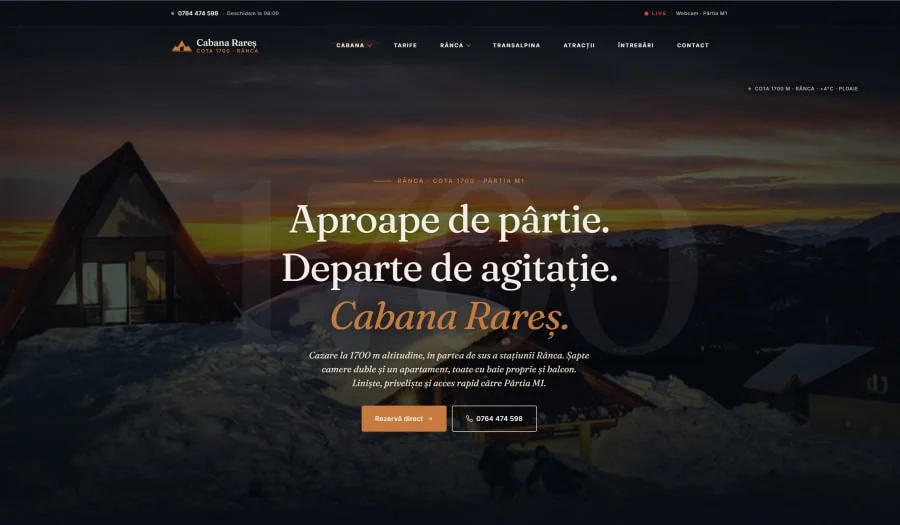
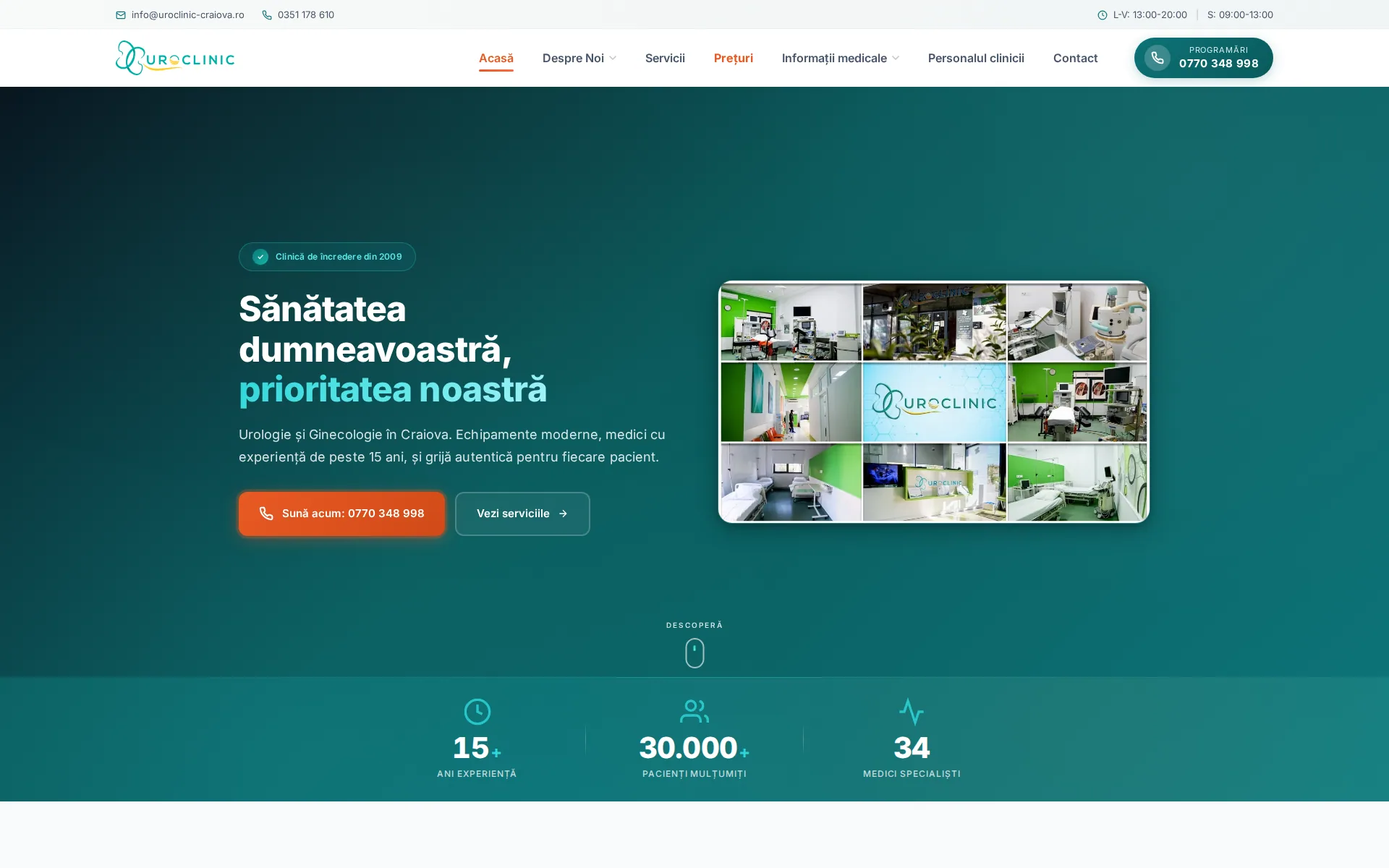
We work from Gorj, and our projects tell the story better than any argument could: a mountain guesthouse in Rânca, a clinic in Craiova, a public institution in Bucharest — plus clients in other counties and abroad. On these projects, distance has never been a topic of discussion; the quality of the work has.
The genuinely interesting part for businesses outside Bucharest: an agency that understands a local market — how people in a county actually search, what the local competition looks like, what customers need to know before they get in touch — can produce more visible results than the same investment in a far more crowded market. That understanding has to be demonstrated through research and specific decisions, not assumed from the supplier's address.
Rather than comparing agencies by address, compare relevant experience, the people who will do the work, the process and availability, the quality of their public projects, the total cost including post-launch, and the handover terms.
The good signs, briefly
So you're not left with only the question list, here's its mirror — what you see at an agency worth working with:
- They ask you questions first. About your clients, about how you make money, about what isn't working now. The solution comes after they understand the problem, not before.
- They explain the alternatives. "You don't need this yet", "this budget covers the simpler version", "something else is enough at this stage". A credible supplier will recommend the simpler option when it fits the need better.
- They speak so you understand. Jargon used as a smoke screen is a choice, not an accident.
- They separate what they can measure from what they can't guarantee. The difference between an estimate, an objective and a promise should be clear from the first conversation.
- Their projects are still alive. Sites launched years ago and still working, fast, maintained — the best clue about what your relationship will look like in year three.
Conclusion
Choosing a web agency is only a lottery if you treat it like one. With twelve questions asked at the right moment, most of the disappointments in this market become predictable — and avoidable. Use the list on every proposal you compare, and ask for the important answers in writing. And if a single thing stays with you from this whole article, let it be this: the right agency isn't the one with the office closest to you or the biggest promises. It's the one whose answers you can verify.